

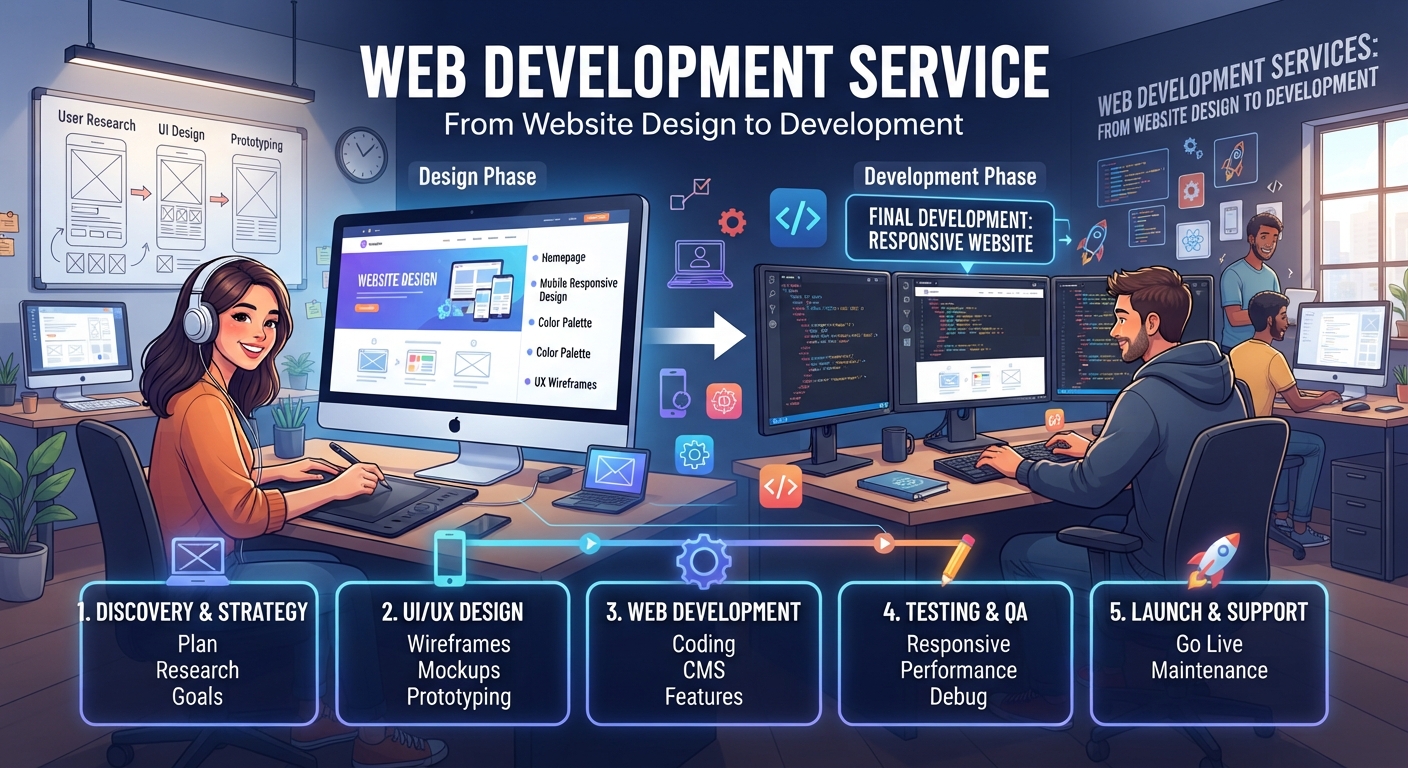
A website is more than a collection of pages displayed in a browser. It combines structure, design, programming, content, data, and server-side functionality to provide a working online experience. A Web Development Service can bring these elements together, from the initial planning and design to development, testing, launch, and maintenance.
Depending on the project, web development may involve HTML, CSS, JavaScript, server-side programming, databases, APIs, content management systems, and other technologies. The right combination depends on what the website or web application needs to accomplish.
What Is a Web Development Service?
A Web Development Service is a professional service focused on creating, developing, testing, deploying, and maintaining websites or web applications. The exact scope can vary from one project to another.
A simple business website may mainly require page development and content management, while a larger web application may require user accounts, databases, APIs, authentication, payment processing, and server-side functionality.
Understanding Web Development Services
Web development includes both client-side and server-side work. Client-side development refers to code that runs in the user’s browser. HTML is used to structure web content, CSS controls presentation and layout, and JavaScript adds programming and interactive behavior.
Server-side development runs on a web server. It can process requests, work with databases, manage application logic, and return information to the browser. A complete Web Development Service may combine both sides to create a website that is functional, maintainable, and appropriate for its intended purpose.
Web Design vs. Web Development
Web design and web development are closely connected, but they focus on different parts of a website project. Web design generally deals with the visual appearance, layout, navigation, interface elements, and user experience. Web development focuses on implementing those designs and building the underlying functionality.
Why Web Development Matters for Businesses
Businesses use websites for many different purposes. A website may provide company information, publish content, display products, generate inquiries, sell products, provide customer services, or deliver an online application.
The development approach should therefore match the purpose of the website. A website that only presents information does not necessarily require the same technical architecture as an e-commerce platform or a data-driven web application. Good development also considers important areas such as accessibility, responsive behavior, browser compatibility, performance, privacy, and security.
What Does a Web Development Service Include?
There is no single package that defines every Web Development Service. The services included depend on the project’s size, features, technology, and objectives.
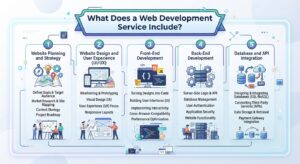
A development project can include planning, design implementation, front-end development, back-end development, database integration, API integration, testing, deployment, and ongoing maintenance.
Website Planning and Strategy
Planning establishes what the website needs to do before significant development work begins. This stage can include defining the website’s purpose, target users, required pages, functionality, content structure, integrations, technical requirements, and project scope.
For more complex websites, planning also needs to consider areas such as user accounts, data storage, permissions, security, and communication between different software components. Clear requirements make Web Development Service easier for developers to determine what needs to be built and which technologies are appropriate.
Website Design and User Experience
Website design determines how users see and interact with the website. Web Development Service can include page layouts, navigation, typography, buttons, forms, menus, content organization, and other interface elements. User experience considerations help ensure that visitors can understand the website and complete relevant tasks.
Accessibility should also be considered during design and development. The Web Content Accessibility Guidelines provide recommendations for making web content more accessible to people with disabilities. A good development process turns the approved design into a functional interface while preserving important usability and accessibility requirements.
Front-End Development
Front-end development focuses on the part of a website that users interact with through their browsers. HTML provides the structure and meaning of web content. CSS controls presentation, styling, and layout. JavaScript provides programming functionality and can make pages interactive and dynamic.
Developers may also use frameworks and libraries when they are suitable for the project. The front end should be developed with consideration for different screen sizes, browsers, input methods, and accessibility requirements.
Back-End Development
Back-end development handles functionality that runs on the server. Server-side code can process browser requests, apply application logic, retrieve or store information, manage user authentication, and communicate with databases or external services.
Common server-side technologies include programming languages and frameworks such as PHP, Python, C#, JavaScript, and their associated frameworks. The appropriate choice depends on the project’s requirements and development environment. Back-end development is particularly important for websites that need dynamic content, accounts, transactions, data processing, or other functionality beyond static pages.
Database and API Integration
Databases are commonly used to store and retrieve information required by websites and web applications. For example, an application may store user accounts, product information, articles, orders, or other records in a database. The server-side application can then retrieve and process that information when users interact with the website.
APIs, or Application Programming Interfaces, provide ways for software components to communicate with one another. A website may use an API to exchange information with another application or service.
How Does the Web Development Process Work?
The exact development process varies between projects, but a typical website project moves through several stages. These stages commonly include requirements planning, design, development, testing, deployment, and ongoing maintenance.
Planning Website Requirements
The process begins by establishing what the website needs to accomplish. Developers and project stakeholders may identify required pages, features, content, user interactions, integrations, technical requirements, and expected users.
The complexity of this stage depends on the project. A small informational website may have relatively simple requirements, while a web application can require detailed specifications for databases, accounts, permissions, APIs, and security.
Creating the Website Design
Once the requirements are understood, the website’s visual and interaction structure can be planned. Designers may create page layouts, navigation structures, interface components, and responsive versions for different screen sizes. The design provides developers with a visual and functional reference for building the website.
Developing the Website
Development converts the planned design and requirements into working software. Front-end developers build the browser-based interface using technologies such as HTML, CSS, and JavaScript. Back-end developers may create server-side functionality, connect databases, and implement application logic. The technologies used depend on the project’s requirements rather than on a single universal technology stack.
Testing and Quality Assurance
Testing helps identify problems before a website is made available to users. Testing may cover navigation, forms, links, interactive features, layouts, responsive behavior, browser compatibility, accessibility, performance, and project-specific functionality.
Security testing is also important for applications that process accounts, personal information, transactions, or other sensitive operations. OWASP’s Top 10 provides a recognized awareness reference for major web application security risks. Testing should be appropriate to the project’s complexity and should continue as important changes are introduced.
Launching the Website
After development and testing, the website can be deployed to a production environment where users can access Web Development Service. A website typically requires hosting or server infrastructure, while its domain name provides a human-readable address. Web browsers communicate with servers using HTTP or HTTPS to request and receive resources.
A launch is not necessarily the end of the development process. Websites may need updates, monitoring, security fixes, content changes, and technical maintenance after publication.
What Technologies Are Used in Web Development?
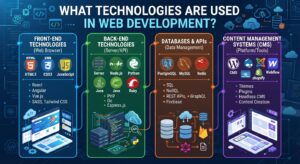
Web development uses a wide range of technologies. The appropriate technology stack depends on the website’s purpose, complexity, performance requirements, development environment, and maintenance needs.
Front-End Technologies
HTML, CSS, and JavaScript form the foundation of modern front-end web development. HTML structures web content and gives Web Development Service meaning. CSS controls how that content is presented, including layouts and visual styles. JavaScript provides programming capabilities that can create interactive and dynamic behavior. Frameworks and libraries can also be used to organize larger front-end projects, but they are built around the underlying capabilities of the web platform.
Back-End Technologies
Back-end technologies run on servers and handle functionality that should not be performed solely in the browser. Examples include server-side environments and frameworks based on languages such as PHP, Python, C#, and JavaScript.
Back-end systems can process requests, interact with databases, authenticate users, apply business rules, and return HTML or data to the client.
Databases and APIs
Databases provide structured storage for information used by websites and applications. Different projects can use different database technologies depending on their data requirements and technical architecture.
APIs provide a defined way for software components to communicate. A website may use APIs to obtain data, send information, connect with external services, or provide functionality to another application. The database and API layer becomes particularly important when a website needs dynamic information or integrations.
Content Management Systems
A Content Management System, commonly called a CMS, is software that helps users create and manage website content. CMS-based development can be useful for websites that need regular content updates, such as blogs, news websites, company sites, and other publishing platforms.
A CMS can reduce the need for users to manually edit the underlying code whenever they need to update supported content. However, the capabilities and technical requirements vary between different CMS platforms.
What Types of Web Development Services Are Available?
Different websites require different development approaches. A Web Development Service can therefore be structured around the type of website being created.
Custom Website Development
Custom website development involves building a website around specific requirements. This can be useful when a project needs a particular design, functionality, workflow, or integration that does not fit a standard template or configuration. Custom development can provide greater control over functionality, but Web Development Service may also require more planning, development, testing, and maintenance.
E-Commerce Website Development
E-commerce development focuses on websites that support online purchasing and selling. Depending on the platform and project, an e-commerce website may include product pages, shopping carts, customer accounts, checkout functionality, order management, and payment integration. Because e-commerce systems can process customer information and transactions, security needs to be treated as an important part of development.
CMS-Based Website Development
CMS-based development uses a content management system to create and maintain website content. This approach can be suitable when website owners or editorial teams need to publish and update content regularly.
The development work can include configuring the CMS, creating templates, developing custom functionality, integrating required services, and applying appropriate security and maintenance practices.
Web Application Development
Web application development focuses on browser-based software that provides interactive functionality. Examples can include customer portals, dashboards, booking systems, management tools, calculators, and other online applications.
Responsive Web Development
Responsive web development focuses on creating layouts and interfaces that adapt to different screen sizes and device environments. A responsive website can adjust its layout, sizing, and presentation according to the available screen space rather than relying on a single fixed desktop layout. This approach is useful because people access websites through a wide range of devices, including desktop computers, tablets, and smartphones.
What Are the Benefits of Web Development Services?
The benefits of a Web Development Service depend on the project’s goals and how well the website is designed and implemented. Professional development can provide the technical foundation for a website that is functional, accessible, maintainable, and suitable for its intended users.
Improved Online Presence
A website provides an online location where an organization can present information, services, products, publications, or other digital resources. Development makes Web Development Service possible to organize that information into functional pages and features that users can access through a browser. The actual value of an online presence depends on the website’s purpose, content, audience, and implementation.
Better User Experience
Web development works together with design to determine how users navigate and interact with a website. Clear navigation, usable forms, responsive layouts, readable content, and accessible interface elements can make a website easier to use. Accessibility is especially important because web content should be usable by people with different abilities and assistive technologies.
Mobile-Friendly Performance
Responsive development helps websites adapt to smaller screens and different device environments. A responsive approach can reduce the need to maintain completely separate desktop and mobile versions of the same website.
However, mobile friendliness is not simply about shrinking a desktop layout. Developers also need to consider navigation, touch interaction, text readability, media, forms, and performance on smaller devices.
Website Security and Reliability
Security is an important part of modern web development. Web applications can face risks involving access control, security configuration, software dependencies, cryptography, injection, authentication, and other areas. OWASP’s current Top 10 identifies these among major categories of web application security risk.
Security practices should be appropriate to the application and its data. They can include secure authentication, access controls, safe handling of user input, secure configuration, appropriate updates, and protection of sensitive information. Reliability also depends on factors such as hosting, application architecture, error handling, monitoring, backups, and maintenance.
Scalability and Business Growth
A website may need to change as Web Development Service requirements change. New content, features, users, integrations, or business processes may be added after the initial launch. A suitable technical architecture can make some future changes easier to implement.
However, scalability is not the same for every project. A small content website and a large web application have different infrastructure and development requirements.
Read more: MyFastBroker Stock Brokers: What Investors Should Know Before Choosing a Broker
How to Choose the Right Web Development Service?
Choosing the right Web Development Service starts with understanding what the website actually needs. Instead of selecting a provider based only on price, consider the provider’s experience, technical capabilities, project scope, communication, testing process, and post-launch support.
Check Experience and Portfolio
Review the provider’s previous projects and look for work that is relevant to your own requirements. A portfolio can show experience with particular website types, design approaches, technologies, and functionality. For a complex project, Web Development Service can also be useful to ask about experience with databases, APIs, authentication, e-commerce, integrations, or other features that your website will require.
Review Services and Technologies
Understand exactly what the provider will deliver. A proposal may include design implementation, front-end development, back-end programming, CMS configuration, database work, API integration, testing, deployment, or maintenance. The technology choices should also have a clear reason behind them. The newest or most popular technology is not automatically the best choice for every project.
Compare Pricing and Project Requirements
Web development pricing varies because project requirements vary. A website with a few informational pages generally involves a different amount of work from a custom application with user accounts, databases, payment processing, integrations, and complex business logic.
When comparing proposals, examine the scope, features, deliverables, timeline, technology, testing, maintenance, and support alongside the price.
Consider Maintenance and Support
Website development does not always end when a website goes live. Depending on the technology and project, ongoing work may include software updates, security fixes, backups, bug fixes, content changes, compatibility updates, monitoring, and new features. Before starting the project, determine whether maintenance is included and what support will be available after launch.
Final Thoughts
A Web Development Service covers much more than simply writing code. Depending on the project, it can involve planning, website design, front-end development, back-end programming, databases, APIs, testing, security, accessibility, deployment, and maintenance.
The best approach depends on the website’s actual purpose and requirements. A small business website may need a relatively simple development setup, while an e-commerce platform or web application may require considerably more complex functionality.
Before starting a project, clearly define the website’s goals, target users, required features, content, integrations, security requirements, and future maintenance needs. Then choose a development approach and service provider that can meet those requirements with an appropriate technology stack.
FAQs About Web Development Service
What is a web development service?
A Web Development Service involves creating, developing, testing, deploying, or maintaining websites and web applications. Depending on the project, it can include front-end development, back-end programming, databases, APIs, CMS development, testing, security, and maintenance.
What is the difference between web design and web development?
Web design generally focuses on the visual presentation, layout, interface, and user experience of a website. Web development focuses on implementing the design and building the website’s functionality.
How long does website development usually take?
There is no fixed development time that applies to every website. The timeline depends on factors such as the number of pages, design complexity, functionality, content requirements, integrations, database needs, testing, and revisions.
How much does a web development service cost?
There is no universal price for a Web Development Service. The cost depends on the project’s scope, design, functionality, technology, integrations, content management requirements, testing, hosting needs, and ongoing support.
Why is responsive web development important?
Responsive web development allows a website’s layout and interface to adapt to different screen sizes and devices.
