


Choosing a stock broker is an important part of investing. Investors need to look beyond advertising or a single fee and consider the services, investment products, costs, account terms, and regulatory background of a brokerage firm.
The term MyFastBroker Stock Brokers can be confusing because MyFastBroker.com is not itself a stock broker. According to its own published information, MyFastBroker.com operates as an independent research and comparison website that provides educational content about brokers. It states that it does not execute trades, hold client funds, or operate as a licensed broker. Understanding this distinction is important before using information from any broker-comparison website.
What Is MyFastBroker Stock Brokers?
Understanding MyFastBroker
MyFastBroker.com describes itself as an independent research and comparison website covering several types of brokers, including stock brokers, mortgage brokers, loan brokers, insurance brokers, real estate brokers, and business brokers. Its website includes a dedicated Stock Brokers section with articles covering investment strategies and other stock-market topics.
Therefore, MyFastBroker Stock Brokers should be understood as a topic referring to MyFastBroker.com’s information and educational coverage of stock brokers, rather than a brokerage company where users open investment accounts.
What Information Does MyFastBroker Provide?
MyFastBroker.com publishes articles intended to help readers research and understand different types of brokers and financial services. Its Stock Brokers category includes material related to investment strategies and brokerage-related subjects.
The site also describes itself as a comparison and research resource rather than a provider of brokerage services. Investors should therefore use its information as part of their research and verify important account details with the actual brokerage firm and relevant regulators.
How MyFastBroker Relates to Stock Brokers
The distinction between an information website and a real brokerage firm is important. Investor.gov defines a broker as a firm or individual involved in buying and selling securities for customers or, in certain circumstances, for its own account. A brokerage account allows customers to place orders for securities through the brokerage firm.
MyFastBroker.com states that MyFastBroker Stock Brokers does not provide those brokerage functions. It does not execute trades or hold customer funds. Its role is instead described as educational and comparative.
How Does MyFastBroker Help Investors Understand Stock Brokers?
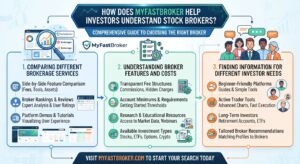
Comparing Different Brokerage Services
Comparison information can help investors identify the factors they need to investigate before opening an account. MyFastBroker.com publishes broker-related research and comparison content, but investors should not assume that information on a comparison website replaces the official disclosures and agreements provided by a brokerage firm.
Understanding Broker Features and Costs
Fees are one of the main factors investors should investigate. Investor.gov recommends considering how much a broker charges for services and transactions, how the broker is compensated, and what products and services are available.
FINRA also explains that commission-free trading does not necessarily mean an account has no other fees or costs. Investors should understand the complete fee structure before opening an account.
Finding Information for Different Investor Needs
Investors have different trading patterns and account requirements. Someone who trades frequently may evaluate brokerage costs differently from someone who primarily buys and holds investments. FINRA recommends considering factors such as trading frequency, fees and expenses, and the level of services an investor wants when deciding between account types.
What Should Investors Look for in a Stock Broker?
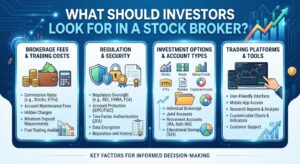
Brokerage Fees and Trading Costs
Investors should examine the complete cost of a brokerage account instead of focusing only on a headline commission. Depending on the account and services involved, costs can include transaction-related charges and other account fees. Investor.gov recommends understanding the fees associated with services and transactions before selecting a broker.
Investors should also read the broker’s current fee schedule and account agreement because actual charges depend on the services and account terms provided by that firm.
Regulation and Security
Regulatory status is another important consideration. Investor.gov recommends researching a broker’s registration, background, and disciplinary history before working with an investment professional.
BrokerCheck, operated by FINRA, allows investors to research registered brokerage firms and individual brokers and review information such as registration, employment history, qualifications, customer disputes, and disciplinary events.
Investment Options and Account Types
Investors should determine whether a brokerage firm provides the products and services they actually need. Investor.gov recommends considering the products and services an investor needs, what the broker offers, any limitations, the associated costs, and potential conflicts of interest.
Account type also matters. FINRA explains that brokerage and advisory accounts can have different services, fee structures, and relationships with customers.
Trading Platforms and Tools
Online brokerage platforms can provide different tools and account features. Investors should examine the functionality they actually need rather than choosing a platform solely because MyFastBroker Stock Brokers advertises a large number of features.
The appropriate platform depends on factors such as the investor’s intended activity, preferred account services, available investment products, and costs.
Key Features to Consider Before Choosing a Broker
Account Requirements and Minimum Deposits
Before opening an account, investors should review the firm’s current requirements, including any minimum balance, eligibility requirements, account restrictions, and applicable charges. FINRA recommends understanding the services and costs associated with an account before deciding which account type is appropriate.
Customer Support and Service
Customer support can be important when investors need assistance with account access, transfers, transactions, or other account-related matters.
Investors should check how a brokerage firm provides customer service and what types of assistance are available. The brokerage firm’s own customer-service information should be treated as the primary source for current support options.
Research and Educational Resources
Educational resources can help investors understand brokerage accounts and investment products before making decisions. MyFastBroker.com describes its content as educational and comparative, while government and regulatory resources such as Investor.gov and FINRA also provide investor education and broker-research tools.
Using more than one reliable information source can help investors distinguish general educational information from the specific terms offered by a brokerage firm.
Mobile and Online Trading Access
Many brokerage firms provide online account access, and some also offer mobile applications. Investors can compare the access methods and features provided by different firms. The important consideration is whether the platform provides the functions the investor needs and whether those services are covered by the firm’s current terms and fees.
How to Compare Stock Brokers Effectively
Compare Fees and Commissions
Investors should compare the total costs associated with each brokerage account rather than looking only at advertised commissions. Investor.gov advises investors to understand how much they will pay for services and transactions, while FINRA notes that other fees may still apply even when an online brokerage advertises commission-free trading.
Check Available Investment Products
The investment products offered by a broker should match the investor’s intended needs. Before opening an account, investors can review the brokerage firm’s available products, account types, restrictions, and related costs. Investor.gov specifically recommends checking what products and services a broker provides and whether there are limitations.
Review Platform Features
Investors can compare practical features such as account access, research tools, order functionality, educational resources, and customer service. A platform with more features is not automatically more appropriate for every investor. The useful comparison is whether the available features match the investor’s requirements and account type.
Verify Regulatory Information
Regulatory information should be verified through authoritative sources. Investor.gov recommends researching investment professionals before engaging with them. FINRA’s BrokerCheck can provide background information about registered brokerage firms and brokers, including registration and disciplinary information.
MyFastBroker Stock Brokers: Safety and Security Considerations
Checking Broker Credentials
When researching MyFastBroker Stock Brokers, investors should first understand that MyFastBroker.com says it is not a brokerage firm. For an actual broker, investors should independently verify the firm’s registration and background through appropriate regulatory databases. BrokerCheck is one resource for researching FINRA-registered brokerage firms and individual brokers.
Protecting Personal and Financial Information
Investors should confirm that they are dealing with the correct company before providing sensitive information. MyFastBroker.com has specifically stated that similarly named domains, including MyFastBroker.net and MyFastBroker.news, are not affiliated with MyFastBroker.com. This makes checking the exact website address an important step when researching information under the MyFastBroker name.
Understanding Risks Before Investing
Choosing a broker does not eliminate investment risk. The value of securities can fluctuate, and investors can lose money. Investors should therefore separate two different questions: whether a brokerage firm is properly registered and whether a particular investment is suitable for their circumstances. Regulatory registration does not guarantee that an investment will be profitable.
Read more : What Is Crypto Staking? A Beginner’s Guide (2026)
Common Mistakes to Avoid When Choosing a Stock Broker
Choosing a Broker Based Only on Low Fees
Low fees may be relevant, but they should not be the only factor in a broker comparison. Investors should also examine services, investment products, account terms, regulatory information, and other applicable costs. Investor.gov recommends considering the overall services and costs associated with a broker.
Ignoring Regulation and Security
Failing to check a broker’s regulatory status can leave investors without important background information. Investor.gov recommends researching registration and disciplinary history before engaging with an investment professional.
Overlooking Account Terms
Account agreements contain important information about services, costs, restrictions, and other conditions. FINRA recommends that investors understand the differences between account types, the services provided, and the associated fees before choosing an account.
Failing to Compare Multiple Brokers
Looking at only one brokerage firm can make MyFastBroker Stock Brokers difficult to understand the differences in services and costs. Investor.gov advises investors to conduct thorough research into a broker’s services, fees, investment offerings, compensation, conflicts of interest, and regulatory or disciplinary history.
Final Thoughts
MyFastBroker Stock Brokers is best understood as a research topic concerning MyFastBroker.com’s educational and comparison content about stock brokers. MyFastBroker.com states that it is not a broker, does not execute trades, and does not hold client funds.
For investors researching a brokerage firm, the safest research process is to look beyond a single comparison website. Review the broker’s official information, understand MyFastBroker Stock Brokers fees and account terms, examine the available investment products and services, and verify regulatory information through appropriate authorities.
MyFastBroker.com can be considered one source of educational information, but the final evaluation of an actual brokerage firm should be based on current information from the broker itself and relevant regulatory resources. This approach gives investors a clearer basis for understanding their options before opening a brokerage account.
FAQs About MyFastBroker Stock Brokers
Is MyFastBroker a Stock Broker?
No. According to MyFastBroker.com’s own published statement, the website is an independent educational and comparison resource.
What Does MyFastBroker Provide About Stock Brokers?
MyFastBroker.com provides research and educational content about brokers. Its website has a dedicated Stock Brokers category covering investment and brokerage-related topics.
How Should Investors Compare Stock Brokers?
Investors should compare the services and investment products offered, fees and expenses, account requirements, regulatory information, potential conflicts of interest, and the level of service they need.
What Fees Should Investors Check Before Choosing a Broker?
Investors should review the firm’s current fee schedule and account agreement and look beyond advertised commissions. Depending on the account and services, other charges may apply.
Why Is Broker Regulation Important?
Regulatory information can help investors determine whether a broker or brokerage firm is registered and identify relevant background or disciplinary information.

6 Comments
Pingback: What Is Startup Booted Financial Modeling? Everything You Should Know
Pingback: FintechZoom.io Stocks Guide: Understanding Stock Research and Market Analysis
Pingback: Python Bug 54axhg5 Explained: Causes, Fixes, and Common Issues
Pingback: Web Development Service: From Website Design to Development
Pingback: 5starsstocks.com Military Explained: Features, Insights, and Important Details
Pingback: Roarleveraging Finance Infoguide from Riproar Review: Is It Reliable?