


A website is often the first place people go to learn about a business, organization, product, or service. But building a useful website involves much more than choosing a template and adding text and images. Behind every functional website are technologies that handle its structure, appearance, interactions, data, and communication with servers.
Web development services cover the technical work involved in creating and maintaining websites and web applications. Depending on the project, this can include front-end development, back-end programming, databases, APIs, content management systems, testing, security, performance improvements, and ongoing maintenance.
What Are Web Development Services?
Web development services are professional services used to build, improve, and maintain websites or web applications. The work can range from creating a simple business website to developing a complex application that processes information, connects to databases, manages user accounts, or communicates with external services.
Modern web development commonly combines client-side technologies such as HTML, CSS, and JavaScript with server-side technologies and databases. The exact combination depends on the purpose and requirements of the project.
Understanding Web Development
Web development is the technical process of creating the structure and functionality of a website or web application.
When you visit a website, your browser communicates with a web server. For a simple site, the server may return stored files such as HTML, CSS, JavaScript, and images. For a dynamic application, the server can process a request, retrieve information from a database, and generate an appropriate response.
What Do Web Development Services Include?
The exact services depend on the project, but common areas include:
- Front-end development
- Back-end development
- Full-stack development
- E-commerce development
- Custom web application development
- CMS development
- Database integration
- API integration
- Website testing
- Performance optimization
- Security improvements
- Website maintenance
A small informational website may need only a few of these services, while a larger application may require most of them.
Web Development vs. Web Design
Web design and web development work together, but they have different primary responsibilities. Web design generally focuses on the visual presentation and user interface of a website. Web development focuses more on turning that design into a functioning website or application.
For example, a designer may determine how a navigation menu should look, while a developer implements the menu so that it actually works when visitors interact with Web development services.
Types of Web Development Services
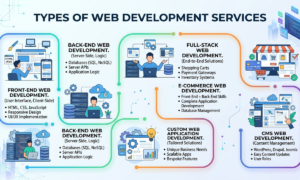
Not every website requires the same type of development. The appropriate service depends on the website’s purpose, functionality, content, users, and technical requirements.
Front-End Web Development
Front-end development focuses on the part of a website that runs in the user’s browser. HTML provides the basic structure of web documents, CSS controls presentation and layout, and JavaScript adds programming logic and interactive behavior. Front-end development can include navigation menus, forms, buttons, interactive components, page layouts, animations, client-side validation, and responsive interfaces.
Back-End Web Development
Back-end development deals with server-side functionality. A server-side application can receive requests from a browser, validate information, communicate with a database, apply business logic, and return an appropriate response. Server-side technologies can include languages such as PHP, Python, Ruby, C#, and JavaScript through Node.js.
Back-end development becomes especially important when a website needs features such as user accounts, product management, database-driven content, order processing, or personalized information.
Full-Stack Web Development
Full-stack development covers multiple layers of a web application, including both front-end and back-end development. A full-stack project may involve the browser interface, server-side application, database, APIs, authentication, and the systems connecting these components.
The term “full stack” does not mean that every developer uses the same technologies. The stack is selected according to the project’s requirements and the team’s technical expertise.
E-Commerce Web Development
E-commerce web development focuses on websites that support online buying and selling. Depending on the business, an e-commerce website may include product pages, categories, search, shopping carts, customer accounts, checkout processes, order management, and payment integration.
Payment functionality normally involves connecting the website with a payment provider or payment-processing service. APIs can provide a way for different software systems to communicate with each other.
Custom Web Application Development
A custom web application is developed around specific requirements rather than being limited to a standard website structure. Examples can include customer portals, booking systems, dashboards, membership platforms, internal business tools, inventory systems, and specialized online services.
Custom applications may use server-side programming, databases, authentication, APIs, and other components to provide functionality that is not available through a basic website alone.
CMS Web Development
A content management system, commonly called a CMS, provides tools for creating, editing, organizing, and publishing website content. CMS development can be useful when a website needs regular content updates by people who do not necessarily work directly with source code. Developers may configure the CMS, create templates, manage content structures, add functionality, configure permissions, and connect the system with other services.
Why Are Web Development Services Important?
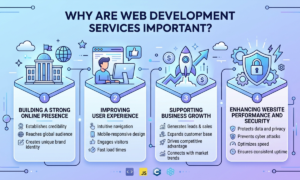
The purpose of web development is not simply to make a website appear online. Development determines how a website works, how information moves through the system, how users interact with Web development services, and how easily it can be maintained.
Building a Strong Online Presence
A website gives an organization a place to present information, products, services, or applications on the web. Web development turns content and design into a functioning digital experience that browsers can load and users can interact with.
The underlying web platform provides technologies for structuring documents, controlling presentation, adding behavior, communicating with servers, and using browser capabilities.
Improving User Experience
Development decisions can directly affect how easily people use a website. Navigation, forms, page responsiveness, interactive elements, error messages, loading behavior, and mobile layouts all contribute to the overall experience. Performance is another important consideration. Google uses Core Web Vitals to measure aspects of loading performance, responsiveness, and visual stability.
Supporting Business Growth
A well-planned website can support changing business requirements by allowing new content, features, integrations, and functionality to be added when necessary. For example, a business might begin with a simple website and later add an online store, customer accounts, booking functionality, or integration with another business system.
Enhancing Website Performance and Security
Performance and security should be considered during development rather than treated as optional additions. Performance can be affected by factors such as page structure, resource loading, application code, and server-side processing. Security can involve access control, authentication, input handling, configuration, software dependencies, and data protection.
OWASP’s current Top 10 awareness document identifies major web application risks including broken access control, security misconfiguration, software supply-chain failures, cryptographic failures, injection, insecure design, and authentication failures.
What Features Can Web Development Services Provide?
The features included in a website depend on its purpose. A basic company website may need only pages, navigation, contact forms, and content management, while a web application may require databases, accounts, search, payments, and external integrations.
Responsive and Mobile-Friendly Design
Responsive development allows a website’s layout to adapt to different screen sizes and devices. This is important because visitors may access the same website using desktop computers, laptops, tablets, or smartphones.
Accessibility should also be considered during development. W3C’s Web Content Accessibility Guidelines provide an internationally recognized framework for making web content more accessible to people with disabilities.
Website Content Management
A content management system can make Web development services easier for authorized users to update website content. Depending on the platform, users may be able to create pages, publish articles, upload images, organize content, and manage other website information without editing the underlying source code. Developers can also customize a CMS to support particular content structures, workflows, permissions, and integrations.
Forms, Search, and Interactive Features
Forms allow visitors to submit information such as contact requests, registrations, search queries, or other data. In a dynamic website, submitted information can be sent to a server, validated, processed, and stored when appropriate. Server-side applications commonly handle tasks such as validating user input and communicating with databases.
Payment and E-Commerce Integration
Payment integration allows a website to connect with a payment service so that customers can complete transactions online. An e-commerce project may connect products, shopping carts, customer information, orders, and payment processing into one workflow.
The exact implementation depends on the chosen e-commerce platform and payment provider. APIs are commonly used when separate systems need to communicate.
APIs and Third-Party Integrations
An API, or Application Programming Interface, provides a defined way for software components to communicate or expose functionality. Web applications can use browser APIs as well as APIs provided by external services. These can support features such as maps, payments, authentication, communication, data retrieval, or other functionality.
Using an external service can save development time, but integrations still need to be tested and maintained because changes to the external service can affect the website.
How Do Web Development Services Work?
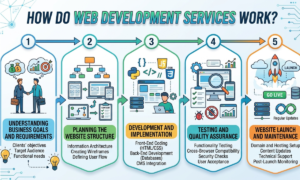
Although every project is different, professional web development normally follows a structured process.
Understanding Business Goals and Requirements
The first step is understanding what the website needs to accomplish. This can include identifying the target users, required pages, features, content, integrations, technical requirements, and expected maintenance needs.
Planning the Website Structure
Planning determines how the website will be organized before significant development begins. This can include the page structure, navigation, content organization, database requirements, user flows, integrations, and technical architecture. Good planning can also reveal potential technical problems before they become expensive to fix.
Development and Implementation
During development, the planned website is turned into working software. Front-end developers build the browser-based interface, while back-end development handles server-side processing when required. Databases may be used to store information, and APIs may connect the website to other systems. Development may take place in stages so that individual features can be built and tested before the complete website is launched.
Testing and Quality Assurance
Testing helps identify problems before users encounter them. Depending on the project, testing may cover links, forms, navigation, functionality, different screen sizes, browsers, performance, accessibility, security, and third-party integrations. Accessibility can be evaluated against standards such as WCAG 2.2, which provides testable success criteria for accessible web content.
Website Launch and Maintenance
After testing and final preparation, the website can be deployed to its hosting environment and made available to users. However, development does not necessarily end at launch.
Websites may need software updates, security fixes, bug corrections, content changes, performance improvements, compatibility updates, and new features over time.
Technologies Used in Web Development
There is no single technology stack that is correct for every website. Developers choose technologies according to the project’s functionality, technical requirements, team expertise, and maintenance needs.
HTML, CSS, and JavaScript
HTML, CSS, and JavaScript form the foundation of modern front-end web development. HTML provides structure, CSS controls presentation, and JavaScript adds programming behavior and interaction. These technologies can be used directly or together with additional libraries, frameworks, development tools, and APIs.
Front-End Frameworks and Libraries
Front-end frameworks and libraries can help developers organize and build more complex interfaces. They can provide reusable components, application structures, development patterns, and tools for handling common tasks.
The right choice depends on the project’s requirements. Using a popular framework does not automatically make a website better; the technology should solve an actual development need.
Back-End Programming Languages
Back-end applications can be built with several programming languages. Examples include PHP, Python, Ruby, C#, and JavaScript through Node.js. Frameworks can provide reusable structures and tools for common server-side development tasks. The most suitable choice depends on the project, existing systems, developer expertise, performance requirements, and long-term maintenance considerations.
Databases and APIs
Databases allow applications to store and retrieve information. A dynamic website can use server-side code to retrieve information from a database and generate an appropriate response for the browser. APIs provide another important connection between software systems. They can allow applications to request information, send data, or use functionality supplied by another service.
Content Management Systems
A CMS provides an interface for managing website content. CMS platforms can be useful for websites where content changes frequently or where multiple people need to create and manage content. A development team may customize the CMS through templates, plugins or extensions, custom functionality, content structures, permissions, and integrations.
Benefits of Hiring Professional Web Development Services
Professional development can be particularly useful when a website requires custom functionality, technical integrations, security controls, databases, or ongoing maintenance.
Access to Technical Expertise
Experienced developers understand how different web technologies interact and can select an approach that fits the project’s requirements. This is particularly useful for websites that require server-side programming, databases, authentication, APIs, security controls, or complex integrations.
Better Website Performance
Website performance depends on many factors, including how resources are delivered, how efficiently code runs, and how quickly servers respond. Performance should be measured rather than assumed. Google’s Core Web Vitals provide standardized measurements for important aspects of page experience, including loading performance, responsiveness, and visual stability.
Improved Security
Security is an important part of responsible web development. Developers need to consider areas such as authentication, authorization, input validation, secure configuration, software dependencies, and protection of sensitive information. OWASP’s Top 10 provides a widely used awareness framework for major web application security risks.
Scalable Website Solutions
Scalability means designing a system that can accommodate changing requirements or increased workload without requiring an entirely new solution. That does not mean every website needs a complicated architecture. A small website may benefit from a simple approach, while a larger application may require additional infrastructure. The important point is to match the architecture to the actual and reasonably expected requirements.
Ongoing Maintenance and Support
Websites are not always “set and forget” projects. Software dependencies can receive updates, third-party services can change, security issues can emerge, and business requirements can evolve. Ongoing maintenance can therefore include updates, bug fixes, security improvements, performance work, content changes, backups, and new functionality.
How Much Do Web Development Services Cost?
There is no universal price for web development. A small informational website and a custom web application can have completely different requirements, so their development costs can also be very different.
Factors That Influence Development Costs
Several factors can affect the total cost, including:
- Number of pages
- Design requirements
- Custom functionality
- E-commerce features
- Database requirements
- User accounts
- API integrations
- Content migration
- Testing requirements
- Security requirements
- Maintenance needs
The more technical work a project requires, the more development and testing may be involved.
Website Complexity and Features
A basic website containing a few informational pages is relatively straightforward compared with an application that includes user accounts, search, dashboards, payments, databases, and external integrations. For this reason, Web development services is better to define the required features before requesting a development estimate.
Custom Development vs. Pre-Built Solutions
Pre-built platforms and CMS solutions can provide existing functionality that reduces the amount of code that needs to be created from scratch. Custom development may be more appropriate when a project has requirements that existing platforms cannot easily satisfy. Neither approach is automatically the right choice. The decision should be based on functionality, customization needs, budget, technical requirements, and maintenance expectations.
Maintenance and Other Ongoing Costs
The initial development cost is not necessarily the total cost of operating a website. Depending on the project, ongoing expenses can include hosting, domain registration, software subscriptions, third-party services, maintenance, security work, and future development. Considering these costs early can make the overall project budget more realistic.
How to Choose the Right Web Development Services
Choosing a development provider requires more than comparing prices. The provider should understand your requirements and have the technical ability to build, test, launch, and maintain the website appropriately.
Check Experience and Portfolio
Review previous projects to see whether the provider has worked on websites similar to yours. Look beyond appearance. If you need an e-commerce website, for example, check whether the provider has experience with shopping carts, product systems, payments, and related integrations. For a custom application, look for experience with databases, user accounts, APIs, and server-side development.
Evaluate Technical Skills
Ask which technologies the provider recommends and why. A strong recommendation should be connected to your project’s requirements rather than simply choosing a technology because Web development services is popular. You should also consider whether the provider can handle testing, security, deployment, and future maintenance.
Compare Services and Pricing
When comparing providers, make sure you are comparing similar scopes of work. One quote might include design, development, testing, deployment, and maintenance, while another might cover development only. Ask for a clear explanation of what is included, what is excluded, and what could create additional costs.
Ask About Maintenance and Support
Find out what happens after the website goes live. Ask whether the provider offers software updates, security fixes, bug resolution, backups, performance improvements, technical support, and future development. This is especially important for websites that use databases, CMS platforms, authentication, or third-party integrations.
Consider Long-Term Business Needs
Think beyond the initial launch. Your website may eventually need new pages, products, features, integrations, users, or content. Choosing a development approach that can reasonably accommodate future changes can make later improvements easier.
Common Web Development Mistakes to Avoid
Understanding common mistakes can help you make better decisions before development begins.
Choosing a Service Based Only on Price
Price is important, but it should not be the only factor. A cheaper proposal may provide fewer features, less testing, limited support, or no maintenance. Compare the complete scope of work rather than comparing numbers alone.
Ignoring Mobile Responsiveness
A website that works well on a desktop but performs poorly on smaller screens can create usability problems. Responsive development allows content and layouts to adapt to different screen sizes.
Mobile accessibility should also be considered as part of broader web accessibility practices. W3C’s accessibility guidance specifically addresses web content across mobile environments.
Overlooking Website Security
Security should be considered throughout the development lifecycle. Problems involving access control, authentication, injection, insecure configuration, and software dependencies can create serious risks for web applications. Using established security guidance, testing practices, and appropriate development controls can reduce avoidable weaknesses.
Failing to Plan for Scalability
Planning for future growth does not mean building the most complicated system possible. Instead, consider the website’s likely requirements and choose an architecture that can reasonably support them. Overengineering can make a project unnecessarily expensive and difficult to maintain, while under-planning can make future changes harder.
Neglecting Website Maintenance
A website can work correctly when launched and still require attention later. Software changes, security updates, browser changes, external integrations, and new business requirements can all create maintenance needs. A simple maintenance plan can help keep the website functional and up to date.
Final Thoughts
Web development services cover the technical foundation that makes websites and web applications function. From front-end interfaces and back-end programming to databases, APIs, content management systems, testing, security, performance, and maintenance, each part can contribute to how effectively a website serves its users. The best development approach is not necessarily the one with the most features or the most popular technology. It is the approach that fits the project’s actual requirements and can be maintained as those requirements change. Before choosing a provider, clearly define what you need, understand the technology involved, compare the complete scope of services, and consider what will be required after launch.
FAQs About Web Development Services
What are web development services?
Web development services include the technical work involved in creating, improving, deploying, and maintaining websites and web applications. Depending on the project, they can include front-end development, back-end programming, databases, APIs, CMS development, testing, security, performance improvements, and maintenance.
What types of websites can web developers create?
Web developers can create many types of websites and web applications, including business websites, blogs, e-commerce stores, membership websites, portals, dashboards, booking systems, and custom web applications.
How long does it take to develop a website?
There is no standard development time for every website. A small informational website may require considerably less work than a custom application with databases, authentication, payment processing, APIs, and extensive testing.
How much do web development services cost?
The cost depends on the scope and complexity of the project. Factors can include design requirements, number of pages, custom functionality, e-commerce features, databases, integrations, testing, and ongoing maintenance.
Does a website need ongoing maintenance?
Many websites benefit from ongoing maintenance, although the amount required varies. Maintenance can include software updates, security fixes, bug corrections, performance improvements, content updates, backups, and changes to third-party integrations.
