

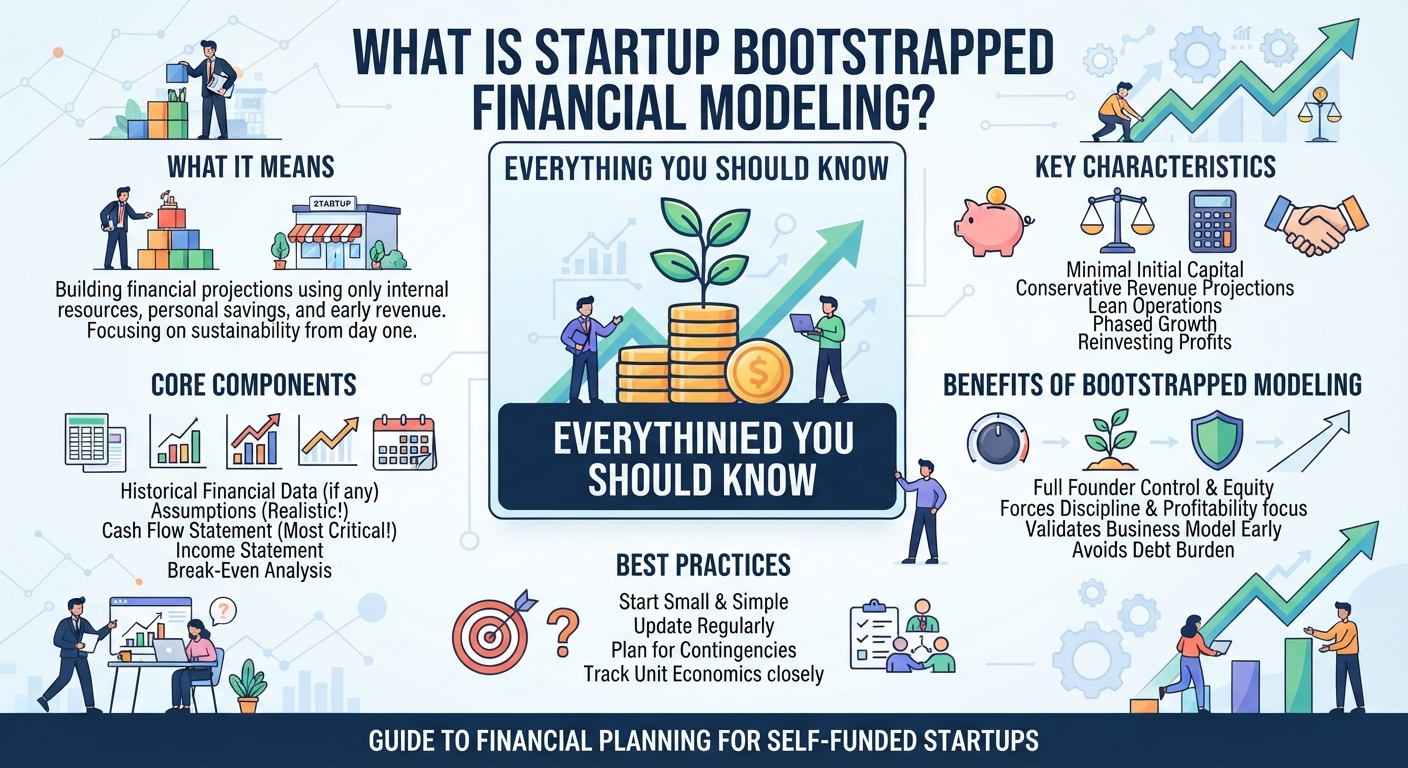
For a startup operating with limited outside funding, understanding the numbers behind the business is essential. Founders need to estimate revenue, track expenses, manage cash, and understand how long available funds may support operations.
Startup Booted Financial Modeling can be understood as financial modeling designed for a bootstrapped or self-funded startup. Although this exact phrase is not a standard accounting term, it combines two established concepts: startup financial modeling and bootstrapping. The U.S. Small Business Administration describes bootstrapping as self-funding a business by using personal financial resources to support the company.
What Is Startup Booted Financial Modeling?
Startup Booted Financial Modeling refers to creating financial projections for a startup that is primarily bootstrapped or self-funded. The purpose is to understand how expected sales, costs, cash movements, and other financial factors could affect the business over a selected period.
Rather than relying on a single financial number, a model connects different parts of the business. A change in projected sales, for example, can affect revenue, expenses, cash flow, profitability, and the amount of funding the business may need.
SCORE’s financial projection models similarly connect startup costs, wages, operating expenses, sales forecasts, income statements, cash-flow statements, balance sheets, and break-even calculations.
The Purpose of Financial Modeling for Startups
The main purpose of financial modeling is to create a structured estimate of the startup’s future financial position. Startup Booted Financial Modeling can help a founder organize assumptions, estimate costs, forecast revenue, and examine whether available resources may be sufficient.
Financial projections are also useful when preparing a business plan or considering financing. The SBA recommends including prospective financial statements and capital-expenditure information when developing detailed financial projections for a business plan.
How Startup Financial Modeling Supports Business Planning
Financial modeling gives the financial side of a business plan more structure. Instead of describing growth or expenses only in general terms, founders can translate those expectations into projected figures. The SBA describes a business plan as a roadmap for starting, managing, and growing a business and recommends financial projections as part of a detailed plan.
For a bootstrapped startup, this process can be particularly useful because the founder may have a limited amount of capital available and needs to understand how planned spending relates to expected revenue and cash availability.
How Does Startup Booted Financial Modeling Work?
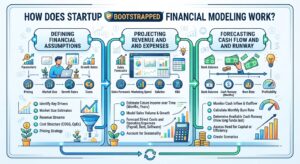
Defining Financial Assumptions
A financial model begins with assumptions about how the business is expected to operate. These may include expected sales, pricing, payroll, operating expenses, startup costs, and other relevant financial factors.
The quality of a projection depends heavily on the assumptions behind Startup Booted Financial Modeling. SCORE advises business owners to understand and explain the assumptions used in financial projections rather than treating projected figures as guaranteed outcomes.
Projecting Revenue and Expenses
The next step is to estimate how much money the business expects to generate and how much Startup Booted Financial Modeling expects to spend.
Revenue projections can be based on expected unit sales, prices, customers, or other appropriate sales measures. Expense projections can include payroll, operating costs, startup expenses, and the cost of goods or services. SCORE’s financial projection templates include these categories in their modeling framework.
Forecasting Cash Flow and Runway
Cash-flow forecasting looks at when money is expected to enter and leave the business. This is different from simply looking at projected profit.
SCORE’s cash-flow projection resources track cash receipts, operating expenses, startup costs, and ending cash balances. They are designed to help entrepreneurs identify potential cash shortages and plan for financial requirements.
What Are the Key Components of Startup Booted Financial Modeling?
Revenue Projections
Revenue projections estimate the sales a business expects to generate during a particular period. A startup might build its forecast using expected customer numbers, units sold, pricing, subscriptions, or another appropriate sales measure.
Operating Expenses
Operating expenses represent the costs involved in running the business. Depending on the company, these can include wages, rent, software, marketing, professional services, utilities, and other recurring expenses.
A financial model should distinguish relevant operating expenses so the founder can see how spending affects projected profitability and cash requirements. SCORE’s templates include fixed operating expenses, payroll, and other operating costs.
Cash Flow Forecasts
A cash-flow forecast estimates expected cash receipts and payments over time. Startup Booted Financial Modeling can show the projected ending cash balance and highlight periods when the business may face a shortage.
SCORE’s current cash-flow resources describe monthly forecasting of receipts, operating expenses, startup costs, and ending cash balances.
Profit and Loss Projections
A projected profit and loss statement estimates revenue, costs, expenses, and the resulting profit or loss over a future period. SCORE’s financial projection model includes projected income statements alongside cash-flow statements and balance sheets, allowing these financial views to work together.
Break-Even Analysis
Break-even analysis identifies the point at which total revenue equals total costs. At that point, the business has neither a profit nor a loss. The SBA defines the break-even point as the point where total costs and total revenue are equal. SCORE also identifies break-even analysis as an important part of financial projections and business planning.
Why Is Startup Booted Financial Modeling Important?
Supporting Better Financial Planning
Financial modeling provides a structured way to estimate future financial results. Startup Booted Financial Modeling can help a founder organize expected revenue, expenses, cash requirements, and other financial information before making business decisions.
SCORE describes financial projections as a business-planning tool that can help startups plan their budgets, estimate when they may become profitable, and establish financial benchmarks.
Understanding Future Financial Needs
A startup may have expenses before Startup Booted Financial Modeling revenue is sufficient to cover them. Financial projections can help estimate how much capital may be required during the early stages of the business.
The SBA recommends calculating startup costs before launching and explains that this information can help estimate profits, conduct break-even analysis, and determine funding requirements.
Managing Startup Resources
Bootstrapped businesses depend substantially on available resources. SBA guidance explains that self-funding can involve personal financial resources and that the founder takes on the financial risk associated with that funding approach.
A financial model can help organize planned spending and compare Startup Booted Financial Modeling with expected revenue and cash availability. This can make resource planning more transparent.
Identifying Potential Financial Risks
A financial model can also be used to examine what could happen when assumptions change. For example, a founder can test a lower sales forecast or higher operating expenses and observe how those changes affect projected results. SCORE recommends considering different scenarios in financial projections, including situations involving higher sales or lower operating expenses.
How to Create a Startup Booted Financial Model
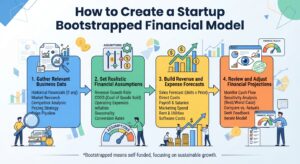
Gather Relevant Business Data
Begin with the financial information available to the business. Depending on the startup’s stage, this can include historical sales, pricing, payroll, startup expenses, operating costs, and other relevant records.
For a new business without much historical data, estimates can be informed by market research, industry information, government data, and comparable businesses. SCORE recommends supporting assumptions with relevant research rather than relying only on guesses.
Set Realistic Financial Assumptions
Next, establish the assumptions that drive the model. These might cover expected sales volume, pricing, customer growth, staffing, operating expenses, and other significant variables.
A realistic model does not require perfectly accurate predictions. Instead, Startup Booted Financial Modeling assumptions should be reasonable, explainable, and updated when better information becomes available. SCORE emphasizes that projections are only useful when the assumptions behind them are honest and supported by appropriate information.
Build Revenue and Expense Forecasts
After establishing the assumptions, create revenue and expense forecasts for the selected period. These figures can then feed into projected income statements and cash-flow calculations.
SCORE’s financial projection models connect sales forecasts and operating costs with projected income statements, cash-flow statements, balance sheets, and break-even analysis.
Review and Adjust Financial Projections
Financial projections should be reviewed against actual business performance. If actual sales, costs, or cash movements differ significantly from the forecast, the assumptions can be reconsidered. SCORE recommends comparing projections with actual results and updating financial information as new figures become available.
What Are the Benefits of Startup Booted Financial Modeling?
Improving Financial Visibility
A connected financial model can bring revenue, expenses, cash flow, profitability, and other financial information into one planning framework. This can make Startup Booted Financial Modeling easier to see how changes in one part of the business may affect other financial results. SCORE’s financial projection models are designed to connect these different financial statements and calculations.
Supporting Business Decisions
Financial projections can provide useful information when evaluating business decisions. A founder can change assumptions in the model and examine how the projected results change. SCORE describes financial planning and projections as tools that can help business owners set goals, monitor results, and support business planning.
Planning for Growth
Growth can increase both revenue opportunities and expenses. A startup therefore needs to consider whether projected cash and revenue can support planned increases in costs.
Longer-term cash-flow projections can help businesses examine expected cash receipts, expenses, and ending balances over an extended period. SCORE provides 24-month cash-flow projections specifically for planning during startup and growth.
Preparing for Funding Discussions
A bootstrapped startup may eventually consider a loan, investment, or another funding source. Clear financial projections can help explain expected financial needs and how funds could be used. The SBA recommends including financial projections when preparing detailed funding requests and matching projected financial needs with the intended use of funds.
What Are Common Startup Financial Modeling Mistakes?
Overestimating Revenue
Revenue forecasts that assume rapid or unsupported sales growth can make a financial model misleading. SCORE notes that revenue projections can be overly optimistic and recommends using realistic assumptions and multiple scenarios when preparing financial forecasts.
Underestimating Expenses
Expenses can also be underestimated when a founder focuses primarily on sales growth. Payroll, operating costs, startup expenses, and cost of goods or services all need appropriate consideration. SCORE’s projection templates include startup expenses, wages, operating expenses, and costs of goods or services as separate financial inputs.
Ignoring Cash Flow
Profit and cash flow are not the same thing. A business can report projected profit while still needing to manage the timing of cash receipts and payments. SCORE explains that cash-flow statements track when cash is received and paid and help businesses understand how much cash remains available for day-to-day activities.
Using Outdated Assumptions
A model becomes less useful when its assumptions no longer reflect the business’s current situation. Regularly comparing forecasts with actual results gives founders an opportunity to revise assumptions and improve future projections. SCORE recommends updating financial projections as actual figures become available.
Read more : MyFastBroker Stock Brokers: What Investors Should Know Before Choosing a Broker
How Can Startups Improve Their Financial Models?
Update Projections Regularly
Financial models should be reviewed as the business generates new information. Actual sales, expenses, and cash-flow data can replace earlier estimates and make future projections more relevant. SCORE’s financial projection guidance recommends updating projections as actual financial information becomes available.
Use Realistic Business Scenarios
Instead of depending on one set of assumptions, a startup can model different possibilities. A base scenario can be accompanied by more conservative assumptions to show how lower revenue or higher costs could affect the business. SCORE specifically recommends using different scenarios to evaluate how changes in sales and expenses may affect profitability.
Compare Forecasts With Actual Results
Comparing projected figures with actual results helps identify where the model was accurate and where Startup Booted Financial Modeling assumptions need adjustment. This comparison is useful because financial forecasting is an ongoing planning process rather than a one-time prediction. SCORE recommends comparing actual results with projections and revising future figures when necessary.
Prepare Multiple Financial Scenarios
Multiple scenarios can help a founder understand the financial effect of different business conditions. For example, the model could include a base case, a conservative case, and a stronger-growth case. SCORE’s financial projection guidance supports scenario analysis and recommends considering how changes in key assumptions can affect projected profitability.
Final Thoughts
Startup Booted Financial Modeling is best understood as financial modeling for a bootstrapped or self-funded startup rather than as a formally established financial methodology. The model can bring together revenue forecasts, operating expenses, cash flow, projected profit and loss, balance-sheet information, and break-even analysis. These elements help founders organize financial assumptions and examine how different business conditions could affect the company.
For a startup relying heavily on Startup Booted Financial Modeling own resources, careful financial planning is particularly relevant because the founder is responsible for managing the available capital and the financial risk associated with self-funding.
FAQs About Startup Booted Financial Modeling
What Is It?
Startup Booted Financial Modeling refers to financial modeling for a bootstrapped or self-funded startup. It helps organize revenue, expenses, cash flow, and other financial assumptions for business planning.
Why Is Financial Modeling Important for Startups?
Financial modeling helps startups estimate revenue, expenses, cash flow, and potential funding requirements. Startup Booted Financial Modeling also gives founders a structured way to evaluate financial plans and business goals.
What Should a Startup Financial Model Include?
A startup financial model may include revenue forecasts, startup costs, operating expenses, cash flow, and profit projections. Depending on the business, Startup Booted Financial Modeling can also include balance sheets, cost estimates, and break-even analysis.
How Often Should a Startup Financial Model Be Updated?
A startup should review its financial model regularly and compare projections with actual business results. Updating assumptions when new financial information becomes available helps keep the model useful.
Can a New Startup Create a Financial Model?
Yes, a new startup can create a financial model even when Startup Booted Financial Modeling has limited historical financial data. Founders can use research, market information, and reasonable assumptions to develop initial projections.
